MathJax

Showing posts with label perfect shuffle. Show all posts

Friday, June 9, 2017

Broken Symmetries 2


The idea of the series was engaging [Messiaen's] maximum attention during these years, and it was probably the influence of this fact that caused him to reflect on the possible strict, and strictly calculated, relationships on which his music might depend; there are many instances in these works of a clear conflict between spontaneity and organization, the one unwilling to abdicate and the other determined to become all powerful. This conflict, or antinomy, is reflected even in the titles of the different pieces written between 1949 and 1951 – Les Yeux dans les roues, Les Mains de l'abíme, Ile de feu.
– Pierre Boulez *

Olivier Messiaen
Performed by Yvonne Loriod
( A score may be located through OCLC WorldCat )


Diagram 1
Compositional scheme of Île de feu 2
(Timings refer to the Loriod recording)


Descriptive Analysis (C2)

The previous post, Broken Symmetries 1, concentrated on the analytical dilemmas posed by the brief passage labelled C1 (mm. 70–75) in Diagram 1. C1 appears, as if out of nowhere, almost exactly half way through the piece as a stream of even pp legato 16th-note triplets. Architectonically, C1 only makes sense to me as a prefiguration of C2, the lengthy section I'm calling the 'Magma Dance' (this begins around 2:55 in the Loriod recording). Like C1, C2 is a double stream of 16th notes, one stream running in the right hand, the other in the left hand.

When I referred to C1 in the previous post as a passage of even triplets in two-voice 'first species counterpoint,' I wasn't entirely joking. Both C1 and C2 are instances of note-against-note counterpoint, but this is 'counterpoint-by-other-means.' I won't yet pursue, let alone formalize, the idea that is slowly emerging here and from other posts in this blog, but a better term for these passages – and many more in the contemporary literature – might be counterset. In our new, still tentative musical world, 'point' may refer to pitch, duration, dynamic, density, chord, key, silence, sample, noise, event, action, choice, instruction, function, feature, preference, intention – in short, any stuff that can make up a musical game of things-and-arrows from a mostly intuitive category theory.

But now to the story of Messiaen's notes and his (and my) 'conflict between spontaneity and organization.'

C1 characteristic that I saved to discuss for comparison to C2 is the disjunct, narrow ranges occupied by each voice in C1. There the left hand spans the range C3–B3 while the right hand stays within the range C4–B4, disjunct from the left hand (Example 1a).[1]

Example 1a                                                   Example 1b

The C2 passage on the other hand was described by Messiaen as 'a cross-handed perpetual motion in the depths of the keyboard.'[2] Example 1b illustrates that the left hand's range in C2 is again bounded within a single octave. Down a fifth from the left hand in C1, it spans F2–E3. The ceiling of the right hand in C2 also drops a fifth from what it was in C1, taking the r.h. ceiling down from B4 to E4; but the r.h. floor drops from C4 down more than two octaves to Bb1, a fifth below the l.h. floor.  As we will soon see, all this 'down-a-fifth' into the depths of the keyboard activity associated with right- and left-hand ranges for the Magma Dance and its prefiguration will be accompanied by a related row transposition at the center of the big puzzle embedded in Île de feu 2.

A final contrasting element is that in C1 both hands are marked pp legato – but in C2 the right hand is marked f staccato against a 'ghosting' left hand that retains the C1 character as p legato. We'll now focus on the ghost in the left hand.

.      .      .      .

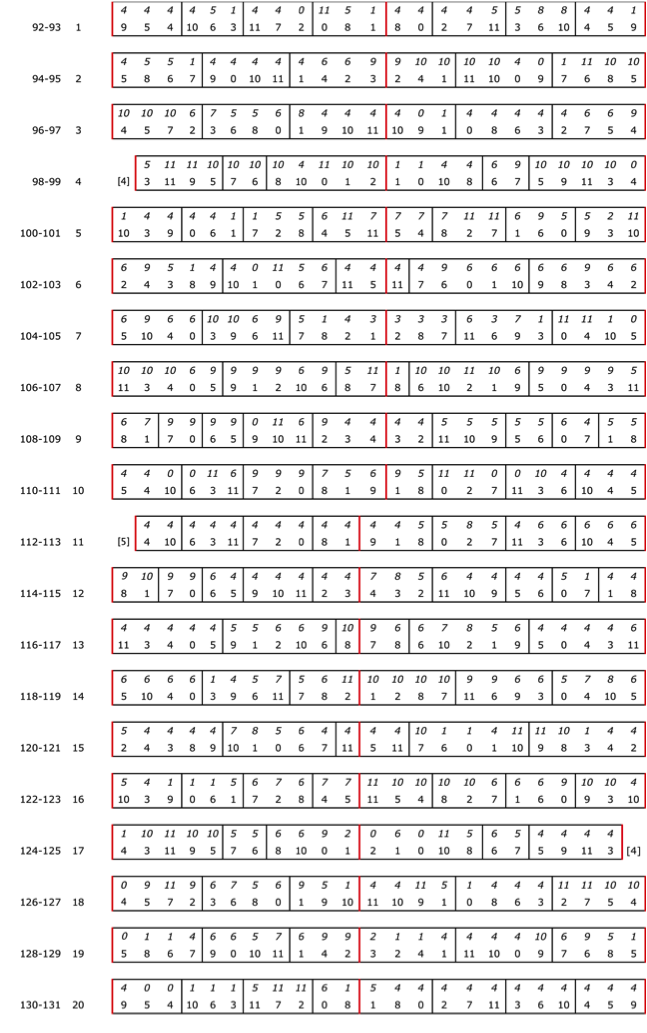
Diagram 2 is a numeric pitch-class transliteration of mm 92–131 so that the lines of the crossing hands can be clearly distinguished for analysis. Each strip represents two measures; the red lines indicate bar lines, the black vertical lines indicate Messiaen's 16th-note groupings. The top row of each strip transliterates the right hand & the bottom transliterates the left hand.

Diagram 2

Let's consider the left hand (bottom half of the strips) which as noted previously spans only one octave, F2–E3. One is immediately struck by the fact that the l.h. in each pair of measures is a 23-note palindrome. So it is tempting to jump immediately to the conclusion that any given l.h. strip consists of a 'twelve-tone row' and its retrograde connected by a common tone as in, for example, the first strip (l.h. of mm. 92–93):

9–5–4–10–6–3–11–7–2–0–8–\   /–8–0–2–7–11–3–6–10–4–5–9


This symmetry has been pointed out elsewhere[3], but I have yet to find a source that notes a second symmetry hiding in the left hand, let alone a source that asks where these 'rows' came from and whether/how they are related to one another and to the right hand. One thing is certain. It is quite misleading to suggest that these pitch-class strings will turn out to be well behaved 'twelve-tone rows' because, as a first quick scan reveals, there isn't a single canonic serial transformation in sight beyond the distinct palindromes we just identified. If C2 were 'serial' in the usual sense that word is taught to be taken, it would mean C2 is a simple concatenation of ten distinct 'tone rows' (which would be somewhat of a record for just one minute of music, and a triumph of compositional randomization.

So we've arrived at Île de feu 2's big puzzle. Now let's see if we can solve it, or at least determine if it is solvable or not. We'll start by isolating the distinct pc-strings.


Diagram 3

Diagram 3 shows that there is a vertical reflective symmetry accompanying the horizontal reflective symmetry, turning C2's left hand part into a house of mirrors. Folding Diagram 3 right to left and then bottom to top yields a 10×12 matrix (Diagram 4).

Diagram 4

This simplifies the analytical focus since it means that, to discover any further relationships within C2 (beyond this two-fold mirror symmetry), we only need to look at any one of the quadrants, since any relationship between 'rows' (or columns, for that matter) in one quadrant will be duplicated or mirrored in the other three. Diagram 4 shows the upper left quadrant.[4] Any relationship we can find among these ten 12-tone strings will be duplicated in the other quadrants.


Antinomous Analysis (C2)


The ten interversions in sections B1, B2 and B3 (compositional scheme, Diagram 1) have been the focus of most commentary about this work. The passage C2 (mm. 92-131, distilled into the matrix shown in Diagram 4), although it is one forth of the entire piece, has been ignored. But the C2 passage is Île de feu's maddeningly elusive big puzzle. Where do these ten strings come from and how are they related to one another (and/or possibly to material outside C2)? The story here is not, as in the fictive analysis of C1 in the previous post, centered on a single anomaly for which we can make up a likely scenario. The analysis below will be seen (at least for now) to describe either an unsolved solvable puzzle or one that has no solution. Such a description is what I mean by 'antinomous analysis.'[5]

All that our strictly descriptive analysis of C2 has given us so far are compelling clues scattered about, any one of which might be ignored as anomalous, but which taken together strongly suggest an as yet undiscovered over-arching pattern which we are compelled to pursue, not knowing whether or not we are running down a blind alley.

So let's begin by trying to find in Diagram 4 all the indisputably non-random features as well as noting the features that suggest randomness.[6] Following is a list of seven compositional features in C2. Each feature is followed by an analytical judgement:
   [] = functionally determined,
   [?] = 'non liquet' ('it is not clear'), i.e., suggestive of a functional relationship that remains undiscovered, or
   [] = tentatively random (no obvious evidence for either [] or [?]).


(1.) To reiterate from the descriptive analysis above, the entire passage in the left hand has a two-fold mirror symmetry. And if you connect identical edges top to bottom and left to right in Diagram 3 you have a torus. []

(2.) String 1 in Diagram 4 can be derived as a 'double retrograde' followed by a (k,n)-perfect shuffle.

Let's say we are given a 'deck' (or set) of 12 pitch classes 0 through 11, and we divide it into k=3 cuts (subsets), each containing n=4 pcs:

[1,2,3,4], [5,6,7,8], [9,10,11,0].

A straightforward 3-way perfect shuffle of these three subsets would take the 'top' remaining element from each ordered subset consecutively and result in the permutation

[1,5,9,2,6,10,3,7,11,4,8,0].

Harmonically, this shuffle would result in four consecutive, equally-spaced augmented triads. But a 'perfect shuffle' doesn't depend on the internal order of each subset, only the order of choosing from each subset. So instead let's begin with a set of pcs cut into three stacks this way:

[9,10,11,0], [5,6,7,8], [4,3,2,1].

This reverses the order of the initial three tetrachords, and then reverses the order of internal elements in the last of the three retrograded chords. We then proceed to interleave this result left to right as a 3-way perfect shuffle. The result is string 1:

[9,5,4,10,6,3,11,7,2,0,8,1].

Note that reversing the final ordered sub-set to read [4,3,2,1] instead of [1,2,3,4], breaks the expected symmetry of equally spaced augmented triads, but the broken symmetry is replaced with a new trichord symmetry:

A : B :: B' : A'

where the As are SC-015 and the Bs are SC-037. A={4,5,9}, A'={8,0,1}=I5(A), B={3,6,10}, B'={7,11,2}=I5(B) (and, of course, the two hexachords are also related by I5). Checking back to Diagram 2 (l.h.) we see that in mm. 92–93 Messiaen grouped the 16th notes in 3's. His grouping appears to be intentionally drawing attention to the string's origin in a composite function drawing from these three sets since, by inspection, it can't possibly be functionally related to the right-hand line. []
<<Added 11.10.15: String 1 is a variation of a pattern found in 'Mode de valeurs et d'intensités' identified as '7. Bars 86-96 (Group II)' (also '6. Bars 81-86 (Group I)' in retrograde) in Robert Sherlaw-Johnson (Messiaen, 1975, p.108, Table II)>>

(3.) String 2 results from successive spiral permutations. Start with the same initial chromatic clusters as we did in String 1, and label them A=[1,2,3,4], B=[5,6,7,8], C=[9,10,11,0]. The first spiral action (identical to a rotation) takes these tetrachords and rearranges them this way: A,B,C → B,C,A. The second spiraling takes the content of each tetrachord and rearranges it this way: [a,b,c,d] → [a,d,b,c]. So B,C,A= [5,6,7,8],[9,10,11,0],[1,2,3,4] becomes

[5,8,6,7],[9,0,10,11],[1,4,2,3],

which is string 2. The initial chromatic tetras are rearranged internally but kept intact harmonically (SC-0123) and related by T4. Checking back to Diagram 2 (l.h.) we see that in mm. 94–95 Messiaen grouped the 16th notes in 4's. Again, it looks like he was grouping by quadruplets according to this string's generating function operating on sets of four elements. []
<<Added 11.10.15: String 2 is a variation of a pattern found in 'Mode de valeurs et d'intensités' identified as '4. Bars 53-57 (Group I)' in Robert Sherlaw-Johnson (Messiaen, 1975, p.108, Table II)>>

(4.) String 5 is generated by simple transposition, T5, from the seed string in passage C1 discussed in  Broken Symmetries 1.

[10,3,9,0,6,1,7,2,8,4,5,11] = T5([5,10,4,7,1,8,2,9,3,11,0,6]).

(... or was C1's seed string derived from String 5 by T7? At any rate ....)

String 5 functionally connects C2 to C1.

As shown in Diagram 2, in mm. 100-101, the 16ths are grouped in 3's, as they were generated in the entire C1 passage, mm. 70–75. []

(It's as though Messiaen is leaving a trail for us by the way he groups sixteenths, relating that to the way the pitches were generated. But this idea is difficult to sustain beyond strings 1, 2, and 5.)

(5.) Strings 1 and 10 in Diagram 4 are related by a simple one-click rotation: the first element in string 1 (pc9) is moved to the end to generate string 10.


[9,5,4,10,6,3,11,7,2,0,8,1] → [5,4,10,6,3,11,7,2,0,8,1,9]. []

(6.) (Hypothetical feature) So now we are left with strings 3, 4, 6, 7, 8, and 9 entirely unaccounted for. Is it possible there is a permutation that could relate all 10 strings, e.g., by interversion as in C1? Trivially, any pair of 12-strings could be treated as a permutation. But it would take a single covering permutation or group of related permutations to knit the matrix together such that we could claim a full solution to the question. For example, we can derive string 3 from string 2 by the permutation (5,4,9,3,11,0,6,7,2,10,8)(1), but this permutation doesn't relate any other pair of strings in the matrix. And the same for any other pair (just pick one element in any string and follow it through its position vis a vis all possible pairs – cf. Table 1 in Broken Symmetries 1). Also, none of these remaining strings can (thus far to me) be related by any permutation from an obvious/relevant external seed string as we found in strings 1, 2 and 5. The idea of knitting the whole matrix together by interversion (iterated permutation) or some obviously related group of permutations must be labeled [] as tentatively random. The reason the judgement remains tentative is due to the next feature observation. Examining the matrix columns, we find something else very suggestive that would seem to increase the odds against randomness for the matrix as a whole.

(7.) Column 5 reads down 6–9–3–5–6–9–3–5–6–3. Omitting the final element 3 which comes from the rotation of string 1 and might be redundant to the pattern, we get two identical vertical 4-string groupings with an extra element 6 tacked on the end: 6–9–3–5 / 6–9–3–5 / 6. Similarly, reading up we get the groupings 6–5–3–9 / 6–5–3–9 / 6.  Another way to look at this is by isolating the 6's: 6 / 9–3–5 / 6 / 9–3–5 / 6 down or 6 / 5–3–9 / 6 / 5–3–9 / 6 up. The middle 6 is element number 5 in string 5. This suggests that string 5, the string related by transposition from the seed string in section C1 is row-wise 'central' to the matrix and might  somehow generate the four strings above and below it. Another (better?) guess is that any string pair (nn+4), where n=1,2,3,4, is related by some yet to be discovered function/transformation/generating principle. I have no idea how to calculate the odds against this symmetry appearing coincidentally in a random draw of ten 12-strings, but I would imagine it's huge. There's enough demonstrable consistency and planning evident to encourage me to continue searching for something I'm overlooking. So I mark this feature highly suggestive (that there is an undiscovered pattern) but inconclusive (and certainly not 'solved'). [?]

There are other features that suggest internal secondary patterns, but the ones above are the obvious ones. Pursuing them is quite a stretch, and the ones I know of are difficult to describe, far-fetched, often end in blind alleys, and (so far) wouldn't change or add anything to my present 'conclusion' about this passage. Obviously it is not possible at this point, given only the information above, to demonstrate that C2 was consciously organized as C1 clearly was – to wrap it up in a neat functional package where everything relates to everything else. Neither is it possible to declare that the unexplained portions are merely random.


.      .      .      .

My conclusion concerning the entire passage C2 is: no conclusion at all – at least in the sense of 'mission accomplished.' The evidence strongly suggests to me that all ten of the ghost strings in the  Magma Dance are derived and, less certainly, interrelated. I can't believe that Messiaen – especially Messiaen – would have functionally generated four 12-strings and then pulled in six random ones out of thin air. It is at least clear to me that in C2 he is conducting his earliest experiments in functional derivation/manipulation of material that go beyond the canonic T, R and I.

I invite others to take up the C2 challenge – and I will take it up again if I can think of an analytical attack I haven't tried – but as of now, I must follow in the steps of those befuddled jurists of old who wrote at the bottom of their undecidable cases:

NL


_____________________

* Pierre Boulez. 'Olivier Messiaen' ('Une classe et ses chimères', tribute to Messiaen on his fiftieth birthday from the programme for the Domaine musical concert of 15 April 1959. Tr. by Martin Cooper, 1986.) In Orientations: collected writings. Edition quoted: Faber & Faber, 1990. p.414.

[1] Ranges are given in scientific notation: C4 = middle C. Apologies for the confusion. I labeled the compositional scheme (Figure 1) without thinking I was planning on also talking about voice ranges. I'll use bold for the compositional scheme & italics for pitch notation here.

[2] Olivier Messiaen. 1994. Programme note in booklet accompanying Koch International Classics 3-7267-2 H1 quoted in Wikipedia article 'Quatre études de rythme'

[3] E.g., John M. Lee. 'Harmony in the Solo Works of Olivier Messiaen: The First Twenty Years.' In College Music Symposium. Vol. 23.

[4] In traditional notation, below is Diagram 4 with pitches as they appear in the score within the delimiting span F2–E3:

[5]

It was tempting at first to call this type of analysis 'inconsistency-tolerant' or even paraconsistent. Then, while reading the 1959 essay by Pierre Boulez from which the above quote is taken, I realized that the kind of analysis I was almost forced into by this section of Île de feu 2 was more precisely seen as a reflection of the 'conflict, or antinomy' Messiaen himself must have faced in creating this passage. In other words, the analytical process itself turns out to be antinomous.

Boulez identified such a feature of a work as a compositional conflict between spontaneity and organization. (One can easily believe he was speaking sympathetically here! The tug between the two has become endemic to music composition – as well as analysis – for more than a century.) So I have identified it similarly, viewing it from the other side, as an analytic-decision conflict between randomness and functionally created pattern. Fitting the present theme, it is also a study in persistent vs. broken symmetries which necessitates discriminating between invariant/covariant and unrelateable features.

[6] Four meditations on 'random.'

   (1) My use of 'random' in this context is not meant to imply its pejorative use accusing the composer of  'pick a note, any note, it doesn't matter', which, when reflected in analysis, is the oft used but seldom recognized academic's gloss, a wave of the hand signifying 'I have no idea, so let's move on.' I mean 'random' to be taken here in the sense of a placeholder for 'the analyst is stumped but [unlike the gloss] can't leave it alone.' This condition reminds one of the prince searching for Cinderella's foot which he assumes will eventually lead to Cinderella, not knowing in the light of day whether or not there is such a foot anywhere in the kingdom, or where the slipper came from, and increasingly facing the possibility that someone will finally dare tell him he spent the night dancing with a figment.

   (2) The word 'random' associated with the arts is often used loosely as a pejorative, but it has objective, non-pejorative meanings in the sciences. My usage here is meant to dismiss the former and respect, if not live up to, the latter. Any feature (say, in the descriptively generated matrix in Diagram 4) that can be shown to have been functionally derived from another feature (inside or outside the matrix) is a formally determined (non-random) feature, whether or not the composer is fully aware of such a determination in this formal sense. The probability that a formally determined feature of a 12-string (not to be confused with the guitar of the same name) could also have been arrived at by blindly drawing 12 notes out of a hat – tripped over, so to speak – is close to zero. Conversely, any feature that cannot be shown to be formally determined in this sense becomes a candidate for being judged analytically as a random feature, and such a feature remains forever a candidate. I add "candidate" as a hedge because it is close to impossible to be certain a feature is random in the sense I am using. How would one provide evidence for creative indeterminacy – call it inspiration or the angel, if you will? Even the composer can't be believed except in the case when s/he is divulging a determined feature (which Messiaen often did). The analyst simply has to learn to live in this suspension.

   (3) As I use the word 'random' in a music-analytic setting, any strictly aural ('it's just what I hear & I can't explain it') preference or other unalloyed preference (by the composer) for selecting one note or pitch-class row or interval string or chord or rhythm or other feature over another is a random selection that is potentially form-inducing. Again: my notion of randomness ignores the pejorative sense of 'pick any note, it doesn't matter'; but it preserves an essential place within techne for inspiration, serendipity, accident, and mistake.

   (4) This sets the stage for analysis of inconsistent features found embedded in a work. Such a feature potentially arises when a preponderance of evidence strongly suggests that a given feature surely must be determined, leading to the conclusion that either the formal determination (function, transformation, whatever) exists but cannot be found, or to the analyst's dreaded conclusion that the feature has no possible formal determination in a sense that relates to the context. It may persist in analytic limbo (undecidable) indefinitely, and its status as determined or random may never be decided definitively. Looked at one way a feature may be judged random, looked at another way it may be judged an un(re)solved determination.


Saturday, August 3, 2013

The Hauptmann Shuffle (2) – Abduction from the diatonic seraglio


     Abduction is the process of forming an explanatory hypothesis. It is the only logical operation which introduces any new idea; for induction does nothing but determine a value, and deduction merely evolves the necessary consequences of a pure hypothesis.
     Deduction proves that something must be; Induction shows that something actually is operative; Abduction merely suggests that something may be.
     [Abduction's] only justification is that from its suggestion deduction can draw a prediction which can be tested by induction, and that, if we are ever to learn anything or to understand phenomena at all, it must be by abduction that this is to be brought about.
     No reason whatsoever can be given for it, as far as I can discover; and it needs no reason, since it merely offers suggestions.

–C.S. Peirce. Collected Papers. V.171

A theory is a cluster of conclusions in search of a premiss.
– Norwood Russell Hanson, Patterns of Discovery (1958)

Stay loose until rigor counts.
 – George M. Prince (co-founder of Synectics)


Don't rush to proof.  Certainty is overrated.


Ignis fatuus: "foolish fire." This will be messy. Terminology will be loose and confusing and inconsistent and contradictory. Ill-defined thoughts will skip from one connection to another with little or no justification outside of serendipity. I am following my nose here and made the conscious decision not to "clean it up" in order to "prove," "make sense," "tell a story," or "convince the reader." There's a kind of dishonesty when you read A→B→C→D→E and you know full well that the way creativity/discovery works is that, in a flash of insight, the author started with C and worked his way out, or with E and worked backward. You read the arrows and assume they were always there to read, as any fool can see.

So my expository model here is closer to Joyce's Ulysses than to Euclid's Elements, but devoid of the genius of either. This is, in my opinion from experience, the way the mind (any mind) works in pursuit of an idea when it has no idea what that idea will turn out to be, and is open to any outcome. For anyone puzzled to know just what a Hauptmann shuffle is: right now I'm still just as puzzled as you are. I simply have (...this is weird...) "blind faith" that there is such a thing. [Cue Monk theme song: "I could be wrong now, but I don't think so."]


I concluded the previous post by saying "a perfect shuffle of a maximally even set will not necessarily result in another max even set (try shuffling the octatonic as one counter example)." This is true, however there may be another reason that the usual 7-note diatonic cycles through its three characteristic forms via the perfect shuffle or its inverse. Such a reason could lead to a conjecture that predicts which structures demonstrate the same "shuffle behavior" as the usual diatonic, and which do not. To explore which other scale structures exhibit the same behavior, we'll start with the 7-note diatonic as a model. First we need to convert the traditional letter notation to integers in the usual way (C=0, C#=1, D=2, ..., B=11)


Then we record the characteristic "signatures" of each shuffle (the cyclic string of chromatic steps between the notes shown as smaller numbers) giving the three forms of the diatonic: a generating stack of six perfect fifths (7) plus one diminished fifth (6): (7777776⤸; overlapping triads (43, 34, 33): (4343433⤸;  and the diatonic scale: (2221221⤸.[1]
Note that each of the three signature strings is maximally even, meaning that
     (a) each is a mirror-symmetric string of integers (to see this, rotate each string to more easily see the symmetry: (7776777⤸, (3434343⤸, (2122212⤸),
     (b) each integer in a given string is either x or y=x+1, and
     (c) the x's and y's are distributed throughout the string as evenly as possible (e.g., the string (21122⤸ fulfills criteria (a) and (b), but the 1's are not distributed evenly with respect to the 2's (they are not as far apart as possible), so it fails criterion (c)).


Note also, since this is a permutation of integers related mod 12, that the sum of all the integers in the interval string in each of the shuffles (48, 24, 12) is a multiple of 12, the "base modulus."[2] So when we substitute other integers/notes/cards to shuffle we expect the three characteristic interval patterns that appear to remain the same, but any interval string sum, while it may change with the shuffle, will always be a multiple of m.[3]
I am assuming that any perfect out shuffle of a deck (string of integers, notes) that produces a maximally even pattern as just described will be an instance of a "Hauptmann Shuffle" (whatever that turns out to be). Symbolically:


shuffle with maximal evenness  ⊂  ?  ⊂  . . .   ⊂  ?  ⊂  Hauptmann shuffle

The next step is to generalize the special case. First, assign some dummy letters so that the pattern of intervals we are looking for is no longer married to the special case.


What remains is the pattern alone without stipulation (b) above, generalizing the pattern to one which is distributionally even, for which maximal evenness is a special case.[4] So now, a "Hauptmann Shuffle" is the family of perfect shuffles that includes any shuffle that cycles patterns that are all distributionally even.


          shuffle with maximal evenness
               ⊂  shuffle with distributional evenness
                       ⊂  ?  ⊂  . . .  ⊂  ?
                             ⊂  Hauptmann shuffle


But we're not quite there yet. A new term would not be called for if all we were talking about was "distributional evenness." And there are intriguing complications ahead.


Next we try a simple test case. Staying with a modulus of 12 (12-tone equal temperament), suppose a=1 and b=6. This will produce a seven-integer string shuffle based on (0123456⤸ which represents the first 7 notes of the 12-tone chromatic scale. Since the perfect shuffle should be familiar by now, let's skip the arrows. Here is how this entire shuffle looks:


Leaving the 12-tone chromatic behind, another interesting shuffle is found by using the interval string (3323332


Some readers will recognize this as the basic 19-tone equally tempered scale system which brings the traditional triad closer to a just tuning by dividing the octave into 19 equal parts. This refinement is important to some ears and has real world form-inducing ramifications as well as expanding tonal material, but is irrelevant to the relationships in the present context since it's still just another example of the basic shuffle pattern. A similar shuffle (moving even closer to approximating just intonation) will result from starting with the interval string (5535553⤸ in 31-tone equal temperament. Other suggestive structures result from swapping string integers such as a "swapped out diatonic" (1121112⤸ (mod 9) or "swapped out 19-TET" (2232223⤸ (mod 16).


Next the question arises, are there strings of length other than seven that produce the same or similar shuffle relationships? We can fully generalize those relationships we have been seeing (so far) with strings of length 7 by first removing elements by pairs as shown in the following diagram to reveal a skeletal structure of strings of length 3.


We can then build back out from the skeleton to interval strings of any odd length 5, 7, 9, 11, 13, etc. using the following instructions that "clone" the red elements:


     – insert "aa" n times at the ellipsis in the first string, or
     – insert "cd" n times at the ellipsis in the second string, or
     – insert two "e"s, one at each ellipsis, n times in the third string

So if we create the pattern, say,  (cdcdcdcdcdcdd⤸ for any intervals c and d by the second insertion rule, we guess that perfect shuffles of the resulting integer string will give us the other related patterns, (eeeeeefeeeeef⤸ & (aaaaaaaaaaab⤸. The next example appears to confirm this but creates a new wrinkle.


We said that building out from any one of the skeleton patterns will give us the other related patterns, but we didn't say how many copies of those patterns.  When dealing with 7-note scales, the perfect shuffle permutation in cyclic notation, using (0123456⤸ from the example above, is (0)(142)(356), which means it will return to original order in just three shuffles. But the initial pattern here, (012345678⤸, uses 9 integers (or notes or cards). The perfect shuffle permutation for that is (0)(157842)(36) which means it takes six shuffles before returning to original order. The pattern holds in this example, but it is doubled. One other interesting thing happens in this example. After three shuffles, the initial cyclic order is reversed (clockwise becomes counterclockwise). So three perfect shuffles starting from (012345678⤸ result in (087654321⤸ and vice versa. And the same for (051627384⤸ ↔ (048372615⤸ and (075318642⤸ ↔ (024681357⤸. Also note that for each pair of strings of elements related by a (cyclical) retrograde, their respective interval strings are related by "inversion" (in music theory terminology); so for the first string above, a=1 and b=3 in the interval pattern, and for its reverse string, a'=10 and b'=8; and a+a'=b+b'=11, the base modulus here.


But now we have to ask, is this cycle of six shuffles actually not a "doubling" of a basic 3-shuffle circuit, but rather a complete "normal" cycle and the 3-shuffle cycle is a "short circuit"? We started by looking at the circle of fifths in 12-TET, but neglected to note that everything that happens there is mirrored in the circle of fourths (or, alternatively, moving counter-clockwise on the circle of fifths). If we begin with a string generated by fourths with the pattern (5555556⤸, and compare it to the string with the same integers, but generated by fifths, with the pattern (7777776⤸, it's apparent that you can't get from one pattern to the other by continuing across the broken line with a perfect shuffle as you can with the (012345678⤸ mod 11 example given above . . .


But we have been assuming that the only permutation to produce these related patterns is a perfect out shuffle. If we investigate the other three permutations in the COIL set for 7-strings, we find the reverse ("inside-out" – not to be confused with the inverse) of the perfect out shuffle.


Its cyclic notation is (3)(146527) so we know it will take 6 shuffles before repeating. Applying it to the perfect-fourth generated (0,5,10,3,8,1,6⤸, it reads (10)(560318) with the fixed point 10 remaining in the "third position" throughout. It produces the following shuffle cycle:


So we now move on to testing that a Hauptmann shuffle is any shuffle that cycles through six iterations – two triples whose interval strings are related by retrograde and all of which are distributionally even. But getting to this point, we've lost the perfect shuffle as the characteristic permutation holding these patterns together. Gaining another shuffle, we're now wondering if there are others:


  • perfect out shuffle  ⊂  Hauptmann shuffle
  • reverse perfect out shuffle  ⊂  Hauptmann shuffle
  • . . .
  • ?  ⊂  Hauptmann shuffle

On the other hand, this complication makes chasing this ghost all the more challenging – and possibly more rewarding. We'll see.


___________________
[1] The notation (abcd⤸ indicates that the elements a,b,c,d are to be thought of cyclically, situated clockwise on a circle. Thus there is no "first element" – (abcd⤸ = (bcda⤸ = (cdab⤸ = (dabc⤸. So, for example, if you are measuring the consecutive intervals in the C-major triad, (CEG⤸, the result will be three intervals: C-to-E (4), E-to-G (3), and "around the corner" G-to-C (5, continuing clockwise on the circle).
[2] What I am tentatively calling the "base modulus" here is assigned intuitively (awaiting formalization?) and mostly for convenience. While it is clear that selection of such a base modulus will affect the specific elements in an interval string, it is not yet clear to me whether/how this choice will affect the patterns resulting from consecutive shuffles. Interpreted "musically," the "base modulus" is the actual size of the underlying horizontal-chromatic/vertical-pulse (equivalence class) universe a composer may have chosen to work in – 12TET, 19TET, 24TET, etc., or metric lengths ("measures") such as 12/4, 9/8, 4/4+1/16, etc.
[3] Taking a foray into geometry, these sorts of structures are said to be conformal and related as homothetic transformations of one another. One of these transformations can be found in 12-tone atonal/serial music theory as the M5/M7 transformation, multiplication of pitch classes by 5 or 7. For example, multiplication by 5 mod 12 maps C-E-G (0-4-7) to C-G#-B (0-20-35 mod 12 = 0-8-11). Considered as a permutation, M5 can be expressed (0)(3)(6)(9)(1 5)(2 10)(4 8)(7 11); homothetically what happens is that the mod 12 chromatic circle (111111111111⤸ explodes into the circle of perfect fourths (555555555555⤸, a mod 60 structure whose base modulus, to preserve octave equivalence, is usually taken as 12.
[4] As far as I know, the term "maximal evenness" was first coined by John Clough and Jack Douthett in their seminal 1991 article, "Maximally Even Sets." It was suggested by a definition of the diatonic scale  by William Drabkin in the New Grove Dictionary of Music as a scale which divides the octave into five whole steps and two half steps with 'maximal separation' between the half steps. Eight years later, Clough and others found it necessary to find a different term for a further generalization of the pattern as they traced it ever deeper into the underworld of musical abstraction. They came up with "distributionally even" as an unavoidable terminological back-fill. So now we have the diatonic as a special case of maximal evenness which itself is a special case of distributional evenness – where we are now finding it meeting up with the perfect shuffle. The field of music scale theory (unlike the subject at its core) is close to impossibly complex due in large part to specialized vocabularies full of jargon that can be confusing and counterintuitive, especially to any beginner. While it is on the technical side, about the best resource that can be accessed on-line for anyone who wants to navigate the labyrinth of scale characteristics and distinctions that have been identified and catalogued over the past half-century is the article by John Clough, Nora Engebretsen & Jonathan Kochavi, "Scales, Sets, and Interval Cycles: A Taxonomy" (even if you only work through the first section).

Thursday, July 18, 2013

The Hauptmann Shuffle (1)


This is one of the most well known diagrams in the history of music in the West, the circle of fifths.[1] This diagram has also been augmented (at least since the mid 17th century) by a second circle of fifths inscribed either within the original circle or, as represented in the next illustration, by adding notes (the red dots with lower case labels) between the originals on the same circle:


This has the advantage of showing all 24 major and minor triads and all 24 major and minor diatonic scales. Any three consecutive nodes represent a triad whose root is the first of the three nodes (when moving clockwise), and any seven consecutive nodes can be rearranged to form a diatonic scale. For example, starting with F and proceeding clockwise to D generates the major triads F-a-C (IV, or subdominant triad in C major), C-e-G (I, or tonic triad in C major), and G-b-D (V, or dominant triad in C major) as well as the minor triads in the C-major scale, a-C-e (vi, submediant) and e-G-b (iii, mediant)


To get to the third remaining minor triad in C major, d-F-a (ii, supertonic) as well as the devilish diminished triad b-d-F (using the same logic), we can employ a more modern trick that amounts to the same thing as the often intricate explanatory strategies of older theorists. Looking at the diagram of the double circle of fifths above, think of snipping the circle just below the d on the left and below the D on the right. Then make a new circle  by joining the d and the D (the numbers indicate half-steps between each node):


We could follow several apparently divergent math paths at this point, not the least of which would begin by noting that this representation of the diatonic set is the maximally even 7-in-24, but right now I'd like to draw these well known concepts into the permutation theme. Remember, this is all about discovering deep connections. Just what does the circle of fifths have to do with spirals, sestinas, coils, perfect shuffles, parallel processing? Take a look at the next diagram from the mid 19th century found in Moritz Hauptman's treatise Die Natur der Harmonie und der Metrik (1853).[2]


What Hauptmann is doing here is tracing a path through his "triad of triads" (a linear representation which is essentially the same as the circular representation of the diatonic set above).[3]  Following this nicely symmetric path reveals the step-wise scale version of the set, for example,
F–G–a–b–C–D–e(–F). 
Bending a few of Hauptmann's curving lines upward, we can see it this way:


... the most familiar version of the coil permutation – the perfect shuffle. Here it's shuffling a deck of just seven cards/notes. In cyclic notation, this permutation is (F)(aGC)(ebd)[4], so we know that after three shuffles we will come back to the original arrangement:


The first note, F in this example, is the only fixed point and remains in the first position with each shuffle, while the other six notes permute as a perfect in shuffle.

But the most interesting thing to me is that you can get from any one of these three well-known orderings of the 7-note diatonic set to the others by applying just one permutation, the perfect out shuffle or its inverse, the outL pretzel – e.g., (F)(aGC)(ebd) or its inverse (F)(CGa)(dbe). A bonus here is that all three are maximally even sets (4343433 (7-in-24); (2221221 (7-in-12); (7777776 (7-in-48)), but after examining what happens when other maximally even sets are shuffled, it becomes obvious that a perfect shuffle of a maximally even set will not necessarily result in another max even set (try shuffling the octatonic as one counter example).


____________________
[1] I am fully aware of the centuries-old controversies concerning tuning problems, but here I will be assuming equal temperament and ignoring just intonation. I am doing this by fiat, not because of any personal preference or because I think ET is "right" and JI is "wrong," but simply to stay on topic to make a point that really has nothing to do with tuning. Tuning theory to one side, even the notes on a badly out-of-tune piano would still have the same underlying abstract relationships being described here, however awful they may sound to the sensitive ear.
[2] This is actually from the 1888 English edition, The Nature of Harmony and Metre, tr. & ed. W.E. Heathcote.
[3] Hauptmann's Roman numerals are not the same as the more familiar chord functions still in use, but explaining them here would take us too far off topic.
[4] If we rotate the circle to start with the scale (deck) arranged CeGbdFa, the result woud be the familiar major scale form CdeFGab and the permutation would be (C)(edG)(bFa), and so on for the other modes (arrangements of the deck).

Wednesday, July 3, 2013

Don't Panic: Parallel processing for intelligent dummies.


Multitasking is a family of four living in a house with one television set.
Parallel processing is a family of four living in a house with four television sets.[1]


The distinction between multitasking and parallel processing is important. But the distinction in humans (if it applies at all) is much more complex than it is in computers. It's imbedded within the knotty questions surrounding "attention."[2] As far as I know, these questions regarding attention for the human mind/brain are far from being settled, and they're a significant part of the subtext in this thread. Fortunately, the case is not (yet) as difficult to understand for the computer as it is for the human.[3]

In contrast to parallel (simultaneity) processing, multitasking is a kind of serial (single time line) processing. But things happen so fast inside a computer that the two are indistinguishable to the user – and are meant to be. So it helps (especially for my purpose here) to slow things down to a sub-computer (human?) speed to watch what's going on. This slowing down, in the example I'm about to give, will reveal the action of the well-known permutation algorithm, the perfect shuffle, presented in the Kevin Houston video I used at the beginning of the "Jeu de Cartes" post.

The following example is a variation on an example taken from a 1971 paper by Harold S. Stone, "Parallel Processing with the Perfect Shuffle." This paper was written at a time when parallel processing was in a relatively early stage of development. It gives four interesting processing applications for the perfect shuffle: the fast Fourier transform[4], polynomial evaluation, sorting, and matrix transposition. The example here will be polynomial evaluation, because the only math needed to understand the action of the perfect shuffle in parallel processing here is multiplication.

In a deck of eight cards labeled 1, 2, 3, 4, 5, 6, 7, 8, the perfect out shuffle looks like this:


The "one-line" notation for this ("coil") permutation is (15263748), and the cyclic notation is
(1)(8)(253)(467). The 1 and 8 are "fixed points" – they don't change in the permutation and so stay on the "outside" after the shuffle, hence the "out" in the designation. 2-5-3 and 4-6-7 cycle through together during consecutive shuffles, indicating that after only three shuffles, an eight-card deck will return to its original order:


Remembering that the objects being permuted need not be the usual consecutive integers, but can be any "objects," we make a substitution mapping all the odd integers 1,3,5,7 to "0" and the even integers 2,4,6,8 to "1".  Leaving off the return permutation, we then have the map:


Now, an "object" in the context here need not be a "noun thing" like a number or an apple or a pitch or a word. It can also be an instruction such as "Do X" or the response to a question such as "Should I do X?" This will be important in a future post.

So we can then treat the perfect shuffle of 0's and 1's as a "mask" or "sieve" so that a "1" tells the computer to do something to a piece of data before letting it pass through to the next step, while a "0" tells the computer to let the datum pass through without doing anything to it.

In the example taken in Stone's paper we want to evaluate a 6th-degree polynomial, which has a formidable look to it


If we were to try this using only our human serial/multi-tasking abilities, or work it on a computer that could only perform SISD (single instruction, single data), we would have to go one step at a time from left to right. The parallel processing suggested by Stone in 1971 feeds all the data in through eight processors simultaneously. At the first stage, each processor asks the mask, "Should I multiply the datum I was given by x?" If the answer is "1" then it multiplies by x and passes the answer on to the next stage. If it's "0" it simply passes on what it was given without doing anything to it. Then the computer shuffles that mask to produce the next mask which answers the question, "Should I multiply by x-squared or not?" Then a final shuffle to answer "Should I multiply by x-to-the-4th or not?"[5]


So if we wanted to evaluate this polynomial for x=2


it would go through in three steps:

Finally, as any Hitchhiker can predict, when you sum all the terms in the end (remember to leave out the 256), the answer will be 42.


Still, there's more to life than 42. The idea to take away from all this is not a more efficient and faster way for a computer to evaluate polynomials, but the idea of permutations of instructions. And that will now lead to some music-world observations about voice leading, neo-Riemannian transformations, and cycles of sonorities in atonal settings – and then moving on to a fantasy on the question, "What did you do in the war, Uncle Miltie?" 


_____________________

[1] I guess I should add this more technical distinction taken from ComputerUser Dictionary:

Multitasking:
In computing, multitasking is a technique used in an operating system for sharing a single processor between several independent jobs. In the case of a computer with a single CPU, only one task is said to be running at any point in time, meaning that the CPU is actively executing instructions for that task. Multitasking solves the problem by scheduling which task may be the one running at any given time, and when another waiting task gets a turn. The act of reassigning a CPU from one task to another one is called a context switchWhen context switches occur frequently enough the illusion of parallelism is achieved. Even on computers with more than one CPU, multitasking allows many more tasks to be run than there are CPUs.
Parallel processing:
Parallel processing is a computing architecture within a single computer that performs more than one operation at the same time. Parallel processing can also be achieved by using multiple computers clustered together to process one part of a large function simultaneously to obtain results faster.
[2] Recommended reading: a summary of philosophies of attention can be found in the online Stanford Encyclopedia of Philosophy.
[3] A helpful tutorial on parallel processing is on the Lawrence Livermore National Laboratory web site.
[4] There is a humorous tale of one man's encounter with fast Fourier transforms at John the Math Guy, a blog devoted to a light hearted but informative approach to many topics in math – highly recommended blog.
[5] Why do these particular multipliers in this particular order make this work?
Hint 1: remember from elementary algebra that
Hint 2: read the mask from top to bottom: 000, 100, ..., 111